
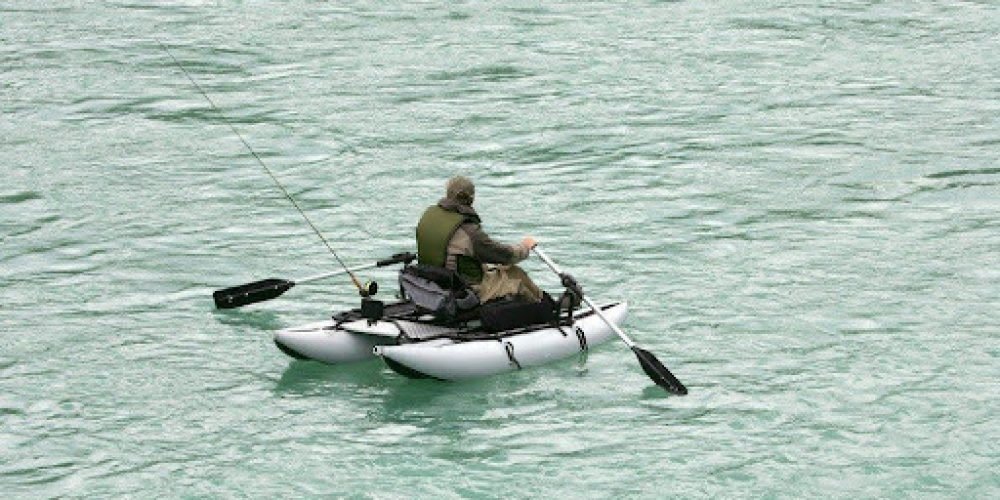
Inflatable pontoon boats have been available to fly fishers for many years and are becoming a very popular method for adventurous anglers to explore their favorite waters. I purchased my first pontoon boat 20 years ago after watching a guy kick around in one on my favorite local bass pond, plucking fish after fish off of a line of reeds I had been eyeing for as long as I can remember. Soon after I returned with my own boat and discovered a plethora of fishy spots accessible only to those that float. The idea is simple; get where you want to be conveniently, comfortably and inexpensively and these boats do it all! I have used mine on lakes and rivers all over California and it has helped me look at fishing from a different angle.
There are several advantages to choosing a pontoon boat as a fishing craft. Float tubes are great for still waters, but I wouldn’t advise using one on a river. Drift boats are also good for their purpose, but they can’t be used on some waters (boat ramps) and require a trailer, tow worthy vehicle and more importantly a place to store it. Also, after paying for all this, plus gas for your truck and shelling out fifty bucks to the shuttle driver, your wallet can start to get pretty thin. There are many pontoon boats on the market priced for the budget conscious angler and they open up a world of fishing options. Most pontoon boats can collapse to fit into the trunk of a regular passenger car too. Their design allows the angler to use them on a variety of water types from small ponds to large lakes and rivers. There are pontoon boats available that can handle almost any situation. When seated between the two large inflatable pontoons the angler is free to use the oars or kick around with fins. In lakes and slow-moving rivers, I enjoy being able to position myself in just the right spot while having my hands free to cast. Then when I want to move on, I simply pull my feet out of the water, set them on the footrests built into the boats metal frame and row on to more fish! In swift rivers I have found an eight-foot pontoon boat to be highly maneuverable and surprisingly stable. Learning to navigate a river in one takes some practice, common sense and you should always keep safety in mind, but it is one of the most fun ways to fish.
There are a few things to think about when buying a pontoon boat. When buying one of these boats it is safe to say that you get what you pay for. The quality of materials and construction on boats like those made by Outcast, Aire, Watermaster and Buck’s Bags is well worth the money you will spend. Most boats come with a set of oars, storage bags and a pump that will most likely break the first time you use it. There are several places you can pick up a better air pump like West Marine, but I prefer and personally use NRS pumps, they make some great pumps and lots of options. I would advise having some kind of anchor system. Some boats come with a rope and anchor while others have these available as optional accessories. You will also need to figure out a way to keep your rod safely out of the water and attached to the boat while you are rowing or running rough water. A company called Scotty makes a reliable rod holder that I have been using for a long time. It clamps to the frame of my boat and can be set in almost any position to keep my rod free of the oars. In rapids it is safer to pack your rod away and strap it to the frame to ensure it is not lost or
broken. A life jacket is an absolute necessity as well as the law. You will need waders if floating in the winter time or colder water, but in the summer time wet floating like wet wading is a great way to stay cool. If you want to have the flexibility of kicking around you will also need a set of fins. There are special fins on the market such as Force Fins, which work quite well and have the advantage of being able to fit over wading boots, but an old set of diving fins will work just fine. Just make sure they are not brightly colored or you might spook the fish!
Look around at various shops as well as doing some research on the internet before you make a final decision. There are boats in all different sizes from four to fourteen feet long and they all come with different features. Keeping in mind where you will be fishing and what the conditions call for will help you pick the right boat. Will you be mostly fishing small lakes and reservoirs? I would go with a boat no larger than ten feet to keep wind and water drag from becoming an issue. Are you planning on floating larger rivers and maybe even taking extended trips where you will need to carry gear such as tents and camping supplies? Maybe a twelve foot boat would be a better choice because they are more stable in heavy current and can handle more weight. The size of your vehicle may be an issue, but in my experience an eight-foot boat will fit into even the smallest of passenger cars when collapsed.
Once you have an idea of what you need and make the right choice on a boat you can start learning how to use it. When floating new water for the first time it is a great idea to hire a guide. Knowing the water is part of what being a guide is all about so a great guide should be able to show you the river and let you know if there are any dangers as well as key you in on fishy areas. If you choose not to hire a guide you will still need to get some practice and do some research before embarking on your boat’s maiden voyage. Best place to practice is on local ponds or small lakes.
A few recommendations:
Boats in order top to bottom, Outcast Cat 9-IR, NRS Approach 100, NRS Slipstream 106, Watermaster Grizzley, Watermaster Kodiak
Im a huge NRS fan and supporter and I’ve recently had the opportunity to work with NRS to redesign their Slipstream rafts and the smaller models are money if you want something a bit more stable, an adjustable frame system and a bigger size over a pontoon. The Slipstream 106 full frame (the biggest boat out of the recommendations) is a great single man raft, a tad small for 2 guys but doable, and the raft weights 75lbs and the frame just a tad lighter. Under 150lbs is pretty sweet if you ask me and very easy to move around with just 1 angler and throw up into the bed of your truck. Their new Approach is a great little option as well. The Approach 100 weights 87lb to 115lb depending on the rowing package you choose. The Approach is prefect to fit in the bed of a truck too. To top that, NRS’s customer service is top notch and the reason Ive been running NRS rafts since 2014.
While I have never owned any of these following boats, they do come highly recommend from fellow anglers and guides. From Outcasts frameless Striker raft, which is the coolest raft I’ve ever seen to any of their pontoons or frameless pontoons, you can’t go wrong with Outcast. By the way Outcast used to be the Aire raft company. Outcast has a pontoon or raft for every possible situation. The other popular raft/pontoon is Watermaster. Their rafts are extremely light weight and both the Grizzly (smaller model without a floor) and Kodiak (bigger model with a floor) rafts have more carrying capacity than a 1-man pontoon and with no frames will even fit into a high-end exotic sports car or your gas friendly Smart Car.
With that all being said there is however one raft/pontoon company on the market that I highly recommend you stay away from as its very unsafe when floating in our Nor Cal Waters and that company is FlyCraft. Ive had a handful of anglers/clients purchase one of their rafts and have flipped them on our rivers in Nor Cal. The last one being on the Lower Sac below Bonneyview and those guys are lucky to be alive. They are great for still waters like ponds and small lakes, but for river fishing please stay away.
-Captain Brian-
The Spey Mechanic