

An Angler’s Guide to Inflatable Pontoon Boats:
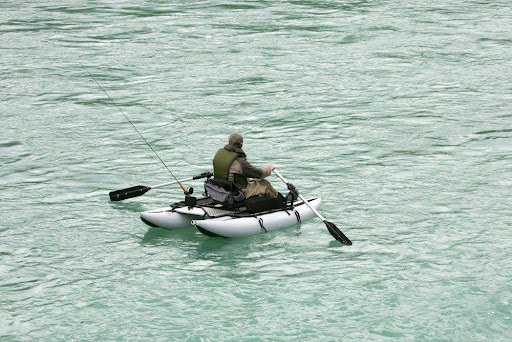
Inflatable pontoon boats have been available to fly fishers for many years and are becoming a very popular method for adventurous anglers to explore their favorite waters. I purchased my first pontoon boat 20 years ago after watching a guy kick around in one on my favorite local bass pond, plucking fish after fish off of a line of reeds I had been eyeing for as long as I can remember. Soon after I returned with my own boat and discovered a plethora of fishy spots accessible only to those that float. The idea is simple; get where you want to be conveniently, comfortably and inexpensively and these boats do it all! I have used mine on lakes and rivers all over California and it has helped me look at fishing from a different angle. There are several advantages to choosing a pontoon boat as a fishing craft. Float tubes are great for still waters, but I wouldn’t advise using one on a river. Drift boats are also good for their purpose, but they can’t be used on some waters (boat ramps) and require a trailer, tow worthy vehicle and more importantly a place to store it. Also, after paying for all this, plus gas for your truck and shelling out fifty bucks to the shuttle driver, your wallet can start to get pretty thin. There are many pontoon boats on the market priced for the budget conscious angler and they open up a world of fishing options. Most pontoon boats can collapse to fit into the trunk of a regular passenger car too. Their design allows the angler to use them on a variety of water types from small ponds to large lakes and rivers. There are pontoon boats available that can handle almost any situation. When seated between the two large inflatable pontoons the angler is free to use the oars or kick around with fins. In lakes and slow-moving rivers, I enjoy being able to position myself in just the right spot while having my hands free to cast. Then when I want to move on, I simply pull my feet out of the water, set them on the footrests built into the boats metal frame and row on to more fish! In swift rivers I have found an eight-foot pontoon boat to be highly maneuverable and surprisingly stable. Learning to navigate a river in one takes some practice, common sense and you should always keep safety in mind, but it is one of the most fun ways to fish. There are a few things to think about when buying a pontoon boat. When buying one of these boats it is safe to say that you get what you pay for. The quality of materials and construction on boats like those made by Outcast, Aire, Watermaster and Buck’s Bags is well worth the money you will spend. Most boats come with a set of oars, storage bags and a pump that will most likely break the first time you use it. There are several places you can pick up a better air pump like West Marine, but I prefer and personally use NRS pumps, they make some great pumps and lots of options. I would advise having some kind of anchor system. Some boats come with a rope and anchor while others have these available as optional accessories. You will also need to figure out a way to keep your rod safely out of the water and attached to the boat while you are rowing or running rough water. A company called Scotty makes a reliable rod holder that I have been using for a long time. It clamps to the frame of my boat and can be set in almost any position to keep my rod free of the oars. In rapids it is safer to pack your rod away and strap it to the frame to ensure it is not lost or broken. A life jacket is an absolute necessity as well as the law. You will need waders if floating in the winter time or colder water, but in the summer time wet floating like wet wading is a great way to stay cool. If you want to have the flexibility of kicking around you will also need a set of fins. There are special fins on the market such as Force Fins, which work quite well and have the advantage of being able to fit over wading boots, but an old set of diving fins will work just fine. Just make sure they are not brightly colored or you might spook the fish! Look around at various shops as well as doing some research on the internet before you make a final decision. There are boats in all different sizes from four to fourteen feet long and they all come with different features. Keeping in mind where you will be fishing and what the conditions call for will help you pick the right boat. Will you be mostly fishing small lakes and reservoirs? I would go with a boat no larger than ten feet to keep wind and water drag from becoming an issue. Are you planning on floating larger rivers and maybe even taking extended trips where you will need to carry gear such as tents and camping supplies? Maybe a twelve foot boat would be a better choice because they are more stable in heavy current and can handle more weight. The size of your vehicle may be an issue, but in my experience an eight-foot boat will fit into even the smallest of passenger cars when collapsed. Once you have an idea of what you need and make the right choice on a boat you can start learning how to use it. When floating new water for the first time it is a great idea to hire a guide. Knowing the water is part of what being a guide is all about so a great guide should be able to show you the
Pursuing Winter Steelhead under and Indicator
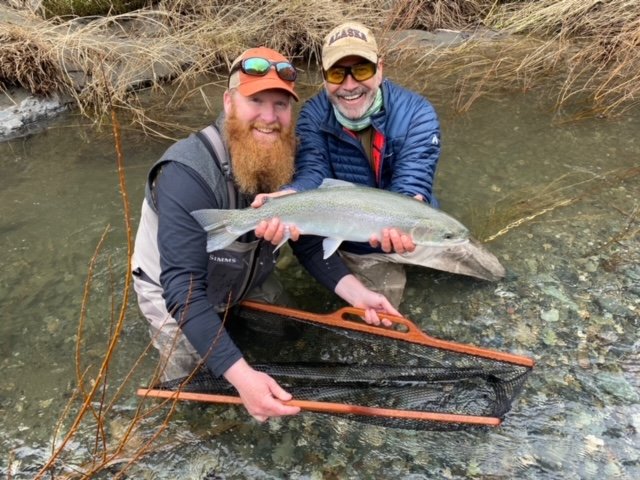
There comes a time every year when we exchange our beautiful dry flies for gaudy chunks of foam, plastic, wood or yarn. There are certainly opportunities to fish with dry flies throughout the winter season, but to consistently hook fish when the thermometer drops it is sometimes necessary to make the switch over to what some consider to be the dark side of fly fishing. Indicator fishing may have its stigmas, but it is a surefire way to improve your catch rate and a great way to learn where fish hold and feed when they are not actively eating on the surface where you can see them. Indicator fishing is pretty easy, but there are some common mistakes that keep many fishermen from unlocking the real potential of the technique. Knowing how to avoid these errors will accelerate your learning curve and help you catch more subsurface feeders! The Dead Drift: The dead drift is your key to success in most nymph fishing situations, but it is overlooked by many fishermen learning to nymph with an indicator. The basic idea is that the indicator acts as a floating hinge point between your leader and fly line above the surface, and the remainder of the leader with your flies attached below the surface. The hinge setup enables your rig to sink at an angle close to ninety degrees, more easily penetrating the current to reach fish holding deeper in the water column. When used properly your indicator setup allows you to drift a fly or a team of flies beneath the surface at the same speed as natural insects that would be swept along the bottom into the waiting mouths of hungry fish, but it takes some practice. The one element to avoid when trying to obtain a dead drift is drag. Drag is the enemy of the dead drift and can be caused by several different variables. If you do not allow significant slack during your presentation by either mending or feeding line into the drift you may have too much tension on your line. A line with no slack will be swept by the main current and cause your flies to swing up off of the bottom, speeding unnaturally away from the fish. To prevent this from happening you must pay attention how the indicator moves in the current. If it is dragging, a “V” shaped wake will form around it, and you know to add some slack in the form of a mend. Observe your indicator as it floats by and take notice at which direction the drag “V” is coming from. If the “V” is pointing upstream, the drag is coming from upstream and by performing a downstream mend this will set things right. If the “V” points downstream your line is probably dragging in the heavy current and pulling the indicator down with it. This situation can occur if you are trying to fish over or across heavy current to softer water on the other side. It can easily be corrected by mending some slack line upstream. Countless beginning anglers assume that if their indicator is floating at the same speed as the surface current, they are getting a perfect dead drift, but this is not always the case. The current in a river is faster on the surface than it is on the bottom. Because of the rough, rocky texture of most river bottoms, drag causes the current to be slowed to almost a halt in some cases when above the river can be blitzing by at full speed. In this situation your indicator might be floating at the same speed as the current, but your flies below will be ripping by the fish at the speed of sound! This is why it is important to cast well upstream of your intended target to give your flies some time to sink. As they are sinking you can make what I like to call an indicator mend. This is basically an exaggerated mend that flicks not only your slack fly line, but your indicator upstream as well. Depending on the speed of the current you can move your indicator anywhere from a few inches to a couple of feet or more upstream of where your flies entered the water. This allows the flies time to sink and get a “head start” on the indicator so it is not dragging them unnaturally. The Strike: Another prevalent mistake anglers make when learning to use a strike indicator is not detecting the strike! Strikes are often much more subtle than you might imagine, and if you are waiting for your indicator to jolt a foot under the water like when you used to fish for bluegill on grandpa’s farm pond you are missing oodles of fish! A fish can inhale your fly, decide it is fake and reject it all in a split second, and even the most seasoned angler might not even know he had a strike. This is why it is very important to focus on the movement of the indicator and set the hook at the slightest bump, pause or unnatural movement. Sometimes your line will rip away and you will know for sure it is a fish, but other times your indicator will simply twitch, twist, tip, tick, pause, move to one side or drag funny in the current and these are all signs of a subtle strike. You may come up with nothing, but hook sets are free and the biggest fish are often the most subtle takers! Have the mindset that its always a fish. As a side note, make sure you choose an indicator to fit the size of water, current speed, flies and shot you are fishing. Many yarn indicators you buy from the shop are overdressed right out of the package and need to be trimmed smaller before they will be useful. I love the New Zealand Strike Indicator Kit as you can make your own size to match the water and
Do’s and Don’t’s when Fishing Fish
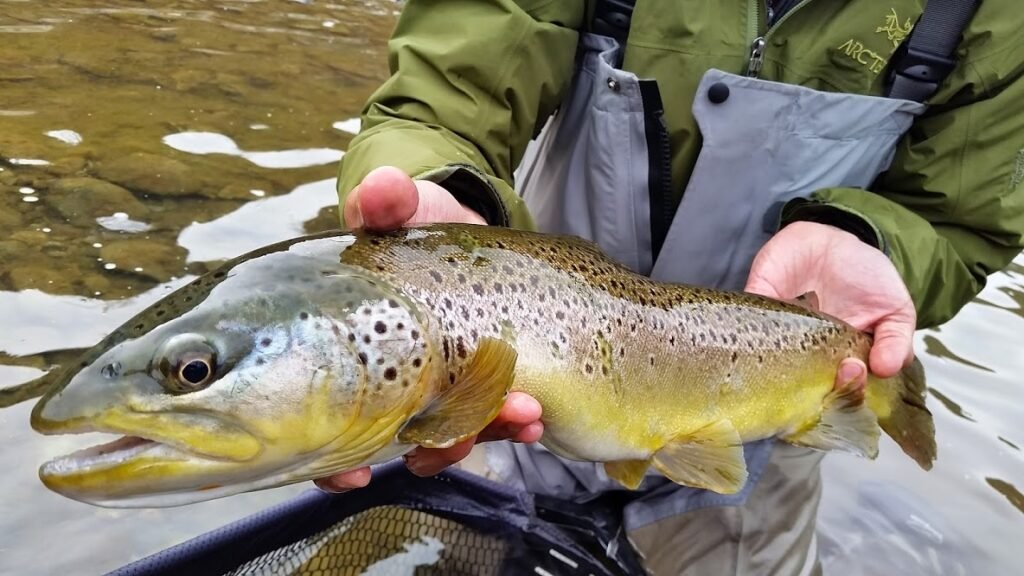
During my career as a guide and as a fisherman I have seen my share of big fish landed and lost. We relish in our victories with wall mounts, photos and epic tales of battling the monster, but the one that got away is always swimming in the depths of our memories. There are always excuses, “I had bad tippet,” or “I would never have landed that thing,” but why chalk it up to a loss when we can learn from our mistakes by evaluating what went wrong during the fight and how we can approach the situation in the future. Fighting a fish is just as much of an art as tying a fly or casting, and must be learned through experience, but here are a few tips so that you won’t be caught dead in the water when that big one comes a tuggin’. Do: Set the hook quickly and firmly. Sets are always free, so set as often as you feel necessary and on any movement or pause of that indicator or tap on that Euro set up. Trout are capable of inhaling your fly and expelling it in a fraction of a second, which is why you must react quickly when you have a strike. A good hook set creates a solid connection between you and the fish and is the foundation for your success in landing a big one, especially with small flies and light tippet. Don’t: Check set, false set or set hesitantly. If you think you have a strike, set the hook! A halfhearted hook set is a sure way to lose the fish of your dreams and will likely leave you with a pile of line in the bushes. Do: Put pressure on the fish. A big fish is capable of moving very quickly and forcefully. In order to counter this, you need to keep the pressure on so that the fish doesn’t get the upper hand by running into log jams, boulders, submerged ledges or strong currents. Try to gain leverage by holding the rod high and lifting the fishes head upwards, down river and into the bank. This will tire the fish out as it attempts to pull its head in the opposite direction and swim deeper. Don’t: Try to muscle the fish. If it runs hard give it some line, but make it work for every inch. If it wants a foot, you give it an inch, if it gives you an inch you take a foot. There is a fine line between too much pressure, and not enough. Just remember to always keep tension on the line and let the fish run if it is pulling hard. Generally, the initial run will only last a few seconds and you can re-gain the advantage, but if you muscle the fish and it breaks free the fight is over. Do: Lead the fish away from obstacles and into slower water down river. A big fish moving fast builds a lot of momentum, but is not very good at stopping. When a big fish is hooked you have the advantage because you can control its momentum. If a big fish is running in heavy current you can pull its head to the side forcing the fish to lean away into the softer water on the edge. The fish will try to pull against you, but as it becomes tired you should be able to use your leverage to steer it where you want it to go. Don’t: Try to drag the fish or hang it in heavy current. I have seen more fish lost like this than I care to recount. The fish is spent and the angler attempts to “surf” it over the current, dragging it across the water towards the waiting net. The fish makes one last pull in the heavy current and the hook pops free. Oh well… Lead the fish into soft water and land it there, it works out much better, trust me! Do: Work the fish quickly and get it in as fast as possible so that it does not overtire. Especially during the hot summer months, trout are susceptible to exhaustion and in order to ensure their survival it is important that we play them with this in mind. Keep an eye on water temps in the summer. Anything over 67-68degs its time to give those fish a rest and hit it again the next morning when water temps are the coolest. Don’t: Overtire the fish. If a trout is belly up as it enters your net its chances of survival are slim. If you play the fish right you should be able to land it in a reasonable amount of time and release it with a good chance of survival. Use leverage and fight the fish into slower water where you can control it better. Most importantly don’t fish in summer to fall months when water temps are the warmest. Rule of thumb is 67/68deg. Do: Net the fish. A good net will protect the fish’s delicate skin coating and keep it from flopping around causing further damage to itself. It will also make it much easier for you to nab your trophy! When you think the fish is ready pull its head out of the water with your rod high and guide the fish head-first into your net. If you jab at it with the net, you risk spooking it, so it is best if you gently let the fish glide to you when it is ready. If you are netting the fish for someone else stay close to them and let them play it out, trying to chase a fish on someone else’s line is a bad idea. You will scare the fish and risk tangling yourself in your partner’s line. If you want to help land the fish, let them fight it out and net it when it is close to them. Also always touch fish with wet hands and